Sore hips after running usually come from the tendons around the hip reacting to a change in training load. The joint, bone and lower back can also be sources. Where it hurts is the most useful first clue, and a few symptoms mean you should stop running and get checked.

Key Takeaways
- Hip injuries are less common in runners, about 3.3% to 11.5% of running injuries, so they are easy to push through until they become long-standing.1
- Outside of the hip: often gluteal tendinopathy, usually after a spike in training load.
- Front of the hip: hip flexor tendinopathy or the hip joint itself, including femoroacetabular impingement (FAI).
- Back of the hip or buttock: the hamstring tendon, ischiofemoral impingement, nerves or the lower back.
- Don't run through night pain, pain with walking, pain at rest, pain spreading into the thigh, or numbness and pins and needles. These need a medical review to rule out a bone stress injury.
- Most cases are managed by modifying running load, strength training and gradual technique changes.
Running is a recreational exercise of choice for many people due to its ease of access, social engagement and general health benefits. According to a systematic review on running injuries, the incidence of lower extremity injury varied between studies from 19.4% to 79.3%. The hip and pelvis were among the least common sites, with hip injury incidence ranging from 3.3% to 11.5%.1 As it is an uncommon region to injure, some runners may continue to push through without recognising that something may be amiss. This can result in long-standing pain, which ultimately limits function and performance.
The hip is a deep, incredibly mobile joint that is surrounded by many tissues including bone, cartilage, muscle and tendons. Running load, training volume, physical capacity and metabolic health all play a role in how a runner tolerates and responds to their training. This blog explores the common running-related injuries of the hip, gives an overview of common contributing factors, and outlines first-line management for these conditions.
What are the most common causes of hip pain in runners?
Hip pain in runners generally falls into 4 broad categories:
- Tendon-related pain – most commonly gluteal, proximal hamstring and hip flexor tendinopathy
- Joint-related pain – including labral pathology, femoroacetabular impingement (FAI), ischiofemoral impingement and osteoarthritis
- Bone-related pain – bone stress injury and stress fracture
- Referred pain – most commonly from the lumbar spine
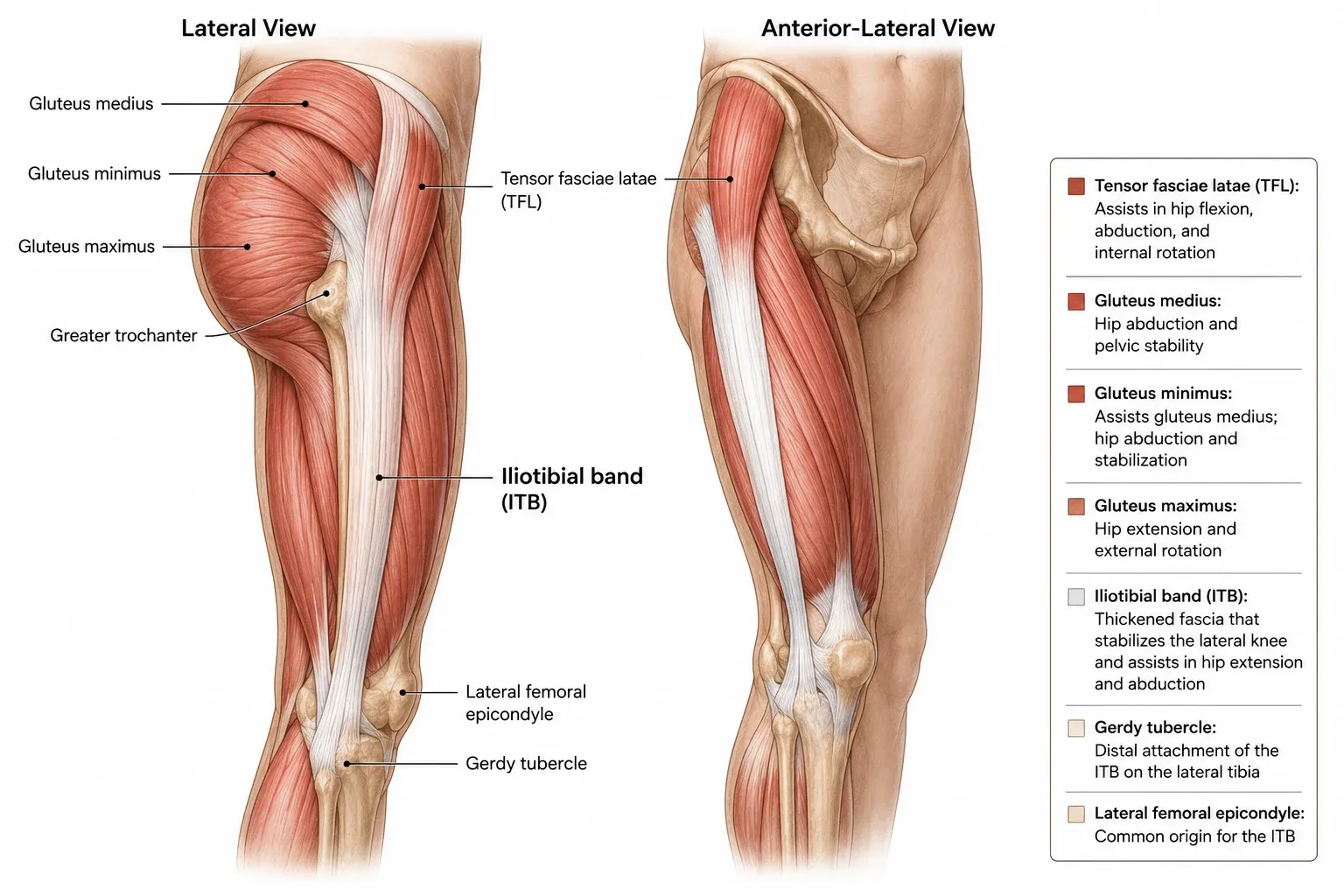
Some cases involve an overlap of different symptom drivers. The illustration below shows some of the muscles and tendons around the outside of the hip.
Where does it hurt? Pain location and likely cause
Pain location and type are useful in working out the likely symptom driver and its severity. However, some symptom drivers can refer pain away from where they are located.
- Outside of the hip: gluteal tendinopathy (greater trochanteric pain).
- Front of the hip or upper thigh: hip flexor tendinopathy, FAI or labral irritation.
- Back of the hip or buttock: proximal hamstring tendinopathy, ischiofemoral impingement, sacral bone stress, or pain referred from the lower back.
- Deep hip or groin: hip osteoarthritis, or a femoral neck bone stress injury (don't run through this).
Lateral hip pain (outside of the hip)
Pain around the outside of the hip, often sensitive to single-leg loading, impact and pressure, can be a sign of gluteal tendinopathy. Pain typically increases with uphill running, stair climbing, single-leg exercises and large volumes of running. It is usually preceded by a large spike in training load (volume, intensity or frequency) beyond what the tendon can handle.
A seemingly gradual onset of lateral hip pain with no clear cause is also commonly seen in females, particularly those who are peri-menopausal or menopausal.2 This is believed to be due to hormonal and metabolic changes, particularly the reduction in oestrogen. Oestrogen is an important ingredient in maintaining healthy tendon tissue. When it is absent or present in lower amounts, this can theoretically reduce tendon tissue quality, and therefore functional capacity.
Anterior hip pain (front of the hip)
Pain at the front of the hip or upper thigh can be associated with hip flexor tendinopathy. This is typically aggravated by uphill running, sprinting and large amounts of speed-based training. Symptoms may appear mild at first, but can worsen and become more limiting if symptom drivers are not addressed.
The hip joint itself and its accompanying cartilage (the labrum) can also be a source of anterior symptoms. The most common anterior joint pathology in runners is femoroacetabular impingement (FAI). FAI relates to the shape of the bones around the hip joint, particularly the neck of the femur (ball) and the acetabulum of the hip (socket).
- Cam lesion: the neck of the femur is slightly thickened, which increases contact and shearing forces against the labrum (outer lining) of the socket, and may change how forces are shared across the joint. A cam lesion is generally considered less favourable.
- Pincer deformity: there is a slight overhang of the acetabular bone, which increases contact against the femur.
It is important to note that these bony shapes are common in people who report no hip pain, and they do not automatically require drastic intervention.3 In FAI, people report symptoms with deep hip flexion and/or pain in the late stance phase of the running cycle (when the leg is behind the body).
Posterior hip pain (back of the hip and buttock)
Symptoms around the buttock can be driven by local tissues, including the hip joint, local tendons such as the proximal hamstring tendon and nerves, or be referred from adjacent regions including the lumbar or sacral spine.
Ischiofemoral impingement, similar to FAI, is caused by increased contact between the ischium and the lesser trochanter of the femur. This contact can irritate not only the bony structures involved, but also the soft tissues and nerves that may be compressed in that region. Symptoms are generally felt during the late stance phase of walking or running, the moment the leg extends behind the body before propelling forward into swing. Pain can be sharp, but can also be an ache, and potentially pins and needles if the surrounding nerve tissues are irritated. This pathology is generally attributed to a training fault, although hip instability secondary to a condition such as hip dysplasia should also be considered.
A high-consequence condition not to be missed is sacral bone stress injury. This is covered together with femoral bone stress below.
Deep hip and groin pain
Deep hip and groin pain can be associated with osteoarthritis (OA), a whole-joint condition that may cause pain both at rest and with activity. It generally presents as a stiff and achy hip, which can be sensitive to impact activities, deep squatting, sitting and moving after long periods of rest. OA is not inherently a capacity issue: a lack of strength and/or endurance does not cause the symptoms. When OA is suspected, other elements also need to be considered, including overall health, diet and recovery. Like FAI, OA can be identified with simple imaging such as an X-ray. However, OA on imaging does not always line up with symptoms.
Bone stress injuries: the hip pain not to run through
Bone stress injuries typically result from an imbalance between bone formation and breakdown. Running subjects the lower limbs to cyclical mechanical loads that cause microdamage within the bones.4 This microdamage stimulates bony adaptation, forcing the body to repair and adapt. When the microdamage exceeds the bone's capacity to adapt, there is a net loss and weakening of bone. Left unmanaged, this can lead to a fracture.
Common areas for bone stress around the hip are the neck of the femur and the sacrum.
- Femoral neck bone stress generally presents with vague but severe pain around the hip, which can extend further down the leg. There is generally an intolerance to running, which can progress to pain with simply walking, and even pain at rest. Many runners mistake this for general "tightness" around the hips. Femoral bone stress is considered more severe and warrants immediate offloading and specialist referral once identified.
- Sacral bone stress generally presents with pain around the back of the hip or buttock. Like femoral bone stress, it can extend down the leg and behave in a similar way.
Risk factors for these injuries are multifactorial, and may include:
- Previous injury
- Inadequate fuelling or dietary insufficiencies leading to relative energy deficiency in sport (RED-S)
- Low bone mineral density
- Running mechanics associated with lower cadence, pelvic drop and high vertical oscillation
A plain X-ray will typically be clear with bone stress. MRI is the preferred imaging for diagnosis.
How is hip pain in runners treated?
Management for most hip-related running injuries follows a simple framework: settle things down, then gradually build back up while working on contributing factors. Unless symptoms are severe (as in the case of bone stress), you can usually continue running to some degree. The key elements are:
- Modify running load – through changes in running frequency, volume and/or intensity.
- Resistance training – although weakness does not cause injury, increasing general strength can help with tolerance to running and with running economy.
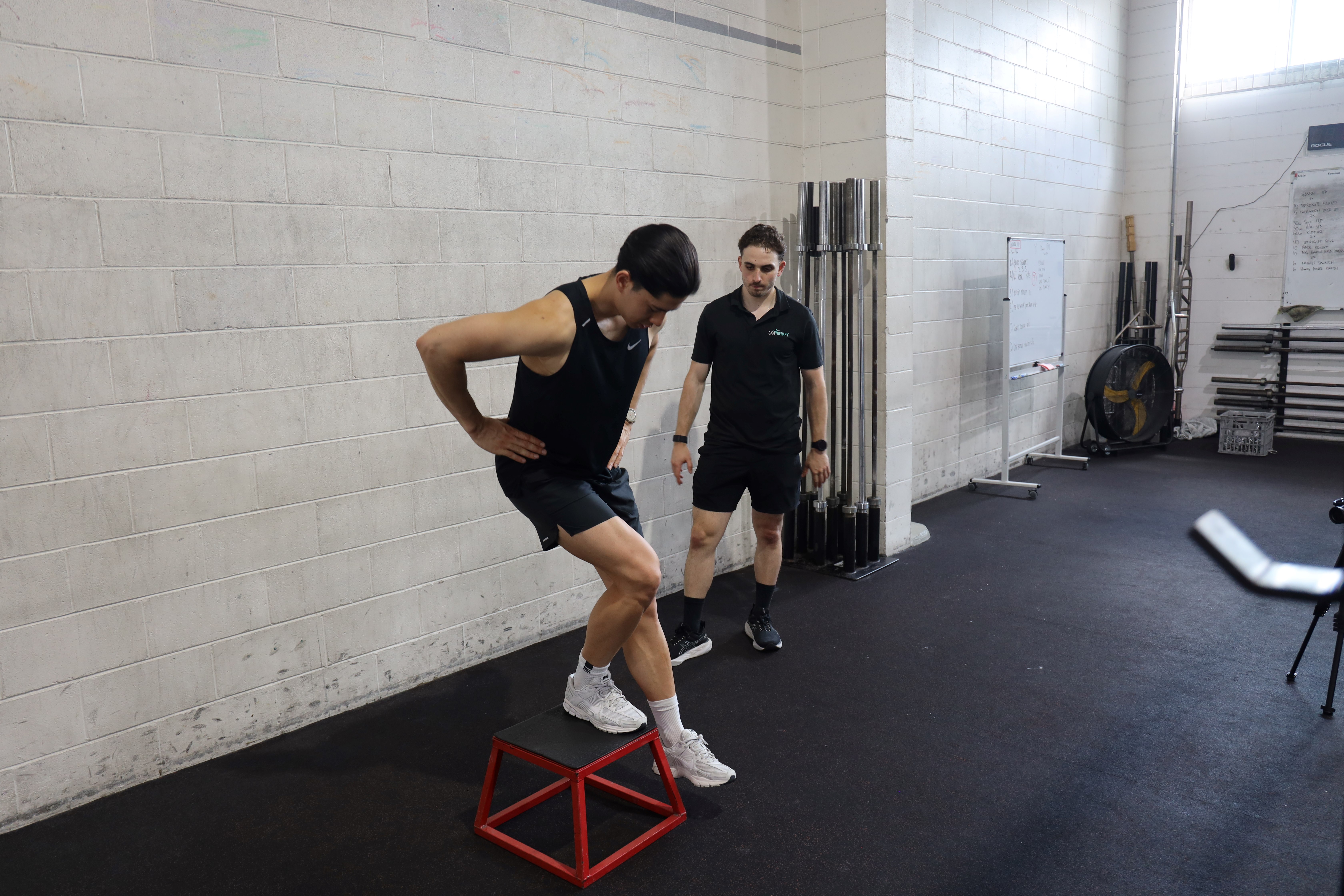
- Consider technical adjustments – changes to step frequency, foot strike and trunk position can shift stress away from sensitive structures. A running gait analysis can show what to change. Make these changes gradually, as stress shifts to other tissues; done abruptly, those tissues may become overloaded.
When to get hip pain checked
Some symptoms are out of the ordinary and warrant a medical review to rule out conditions such as bone stress, which need further investigation:
- Night pain
- Pain simply with walking (weight-bearing)
- Pain that extends into the thigh
- Nerve-type symptoms such as numbness or pins and needles
Conclusion
Although uncommon in runners, hip-related injuries can still be severe and lead to significant time away from running. Pain location gives insight into the likely tissues involved, but more than one tissue can be involved. Effective management starts with an accurate diagnosis: identifying the problem structures and the factors contributing to symptoms. Most respond well to careful running modification, load management and an appropriate exercise plan.
If you or someone you know has been running with hip pain that is not settling, you can book a hip and running assessment, such as our RunLab running injury assessment, at any of our GymTherapy clinics in Newstead, West End and Woolloongabba. See more on our physio for runners page.
Frequently Asked Questions
Why do my hips hurt after running?
Most hip pain after running comes from the tendons around the hip, such as the gluteal or hip flexor tendons, reacting to a spike in training volume, intensity or frequency. The hip joint, bone stress and pain referred from the lower back are less common causes. Where it hurts is the best first clue.
Should I keep running with hip pain?
Usually you can keep running to some degree while you reduce load and build strength. Stop and get a medical review if you have night pain, pain when walking or at rest, pain spreading into the thigh, or numbness or pins and needles, as these can point to a bone stress injury.
What causes pain on the outside of the hip when running?
Pain on the outside of the hip is often gluteal tendinopathy. It tends to be worse with hills, stairs, single-leg exercises and high running volume, and usually follows a jump in training load. It is also common in peri-menopausal and menopausal women.
What does a hip stress fracture feel like?
A femoral neck bone stress injury usually causes vague but severe pain around the hip or groin that can spread down the leg. It often starts as pain with running, then progresses to pain with walking and even at rest. Many runners mistake it for tightness. It needs prompt offloading and medical review.
Do I need a scan for hip pain from running?
Not always. An X-ray can show FAI or osteoarthritis, but these findings are common in people without pain and do not always match symptoms. If bone stress is suspected, MRI is the preferred scan because an X-ray is usually clear.
Written by Jonathan Parra, MSc Physiotherapy, AHPRA-registered physiotherapist at GymTherapy. This article is general information only and is not a substitute for an individual assessment.
Book Now
References
- van Gent RN, Siem D, van Middelkoop M, et al. Incidence and determinants of lower extremity running injuries in long distance runners: a systematic review. British Journal of Sports Medicine. 2007;41(8):469–480. DOI: 10.1136/bjsm.2006.033548
- Kruse CC, McKechnie T, Dworsky-Fried J, et al. Musculoskeletal manifestations of perimenopause: a systematic review and meta-analysis of 93,021 women. JBJS Open Access. 2026;11(1). DOI: 10.2106/JBJS.OA.25.00254
- Thier S, Gerisch D, Weiss C, Fickert S, Brunner A. Prevalence of cam and pincer deformities in the X-rays of asymptomatic individuals. BioMed Research International. 2017;2017:8562329. DOI: 10.1155/2017/8562329
- Loundagin LL, Schmidt TA, Edwards WB. Mechanical fatigue of bovine cortical bone using ground reaction force waveforms in running. Journal of Biomechanical Engineering. 2018;140(3). DOI: 10.1115/1.4038288