Plantar fasciopathy represents one of the most common running injuries, accounting for substantial training time loss and representing a frustrating barrier to performance. Unlike acute injuries, plantar fasciopathy develops over time through cumulative loading. Many runners report no recalled injury mechanism, only progressive heel pain that worsens during training and persists after runs. Runners also report pain first thing in the morning, which improves over a few minutes.
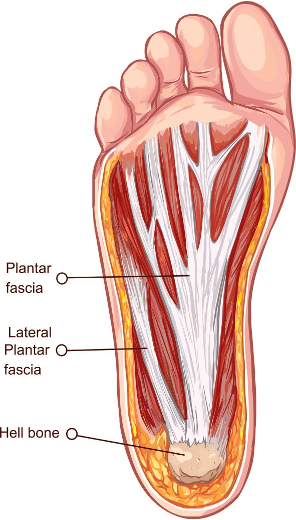
Runners are particularly susceptible due to the extreme loading demands of running; with each ground contact, the plantar fascia experiences tensile forces several times body weight. Repetitive microtrauma from inadequate load tolerance, combined with running-specific biomechanical deficits, metabolic and lifestyle factors gradually leads to biological changes: collagen fibre disorganisation, mucoid degeneration, and neovascularisation.¹ Modern understanding confirms that the condition predominantly involves biological changes and sensitivity to loading, rather than being largely inflammatory, hence "fasciopathy" being the preferred term to "fasciitis."²
For runners, the distinction between plantar fasciopathy and other heel pain generators is critical; misdiagnosis leads to ineffective training modifications and prolonged disability. Accurate diagnosis permits targeted rehabilitation addressing the mechanical drivers of overload in running, as well as identifying other factors that may be contributing to tissue sensitivity.
ANATOMY / PHYSIOLOGY OF THE PLANTAR FASCIA
The plantar fascia is a thick fibrous aponeurosis spanning from the calcaneus to the metatarsal heads, forming the primary support structure for the medial arch. In running, the fascia undergoes extreme loading. Understanding its structural organisation and load distribution role is therefore essential for targeted rehabilitation.
STRUCTURAL ORGANISATION
The plantar fascia comprises three anatomical layers: the medial band (most substantial), central band, and lateral band. The medial band, originating from the medial tubercle of the calcaneus, extends anteriorly along the arch to insert into the metatarsal heads and digital flexor sheaths. This band bears the majority of arch loads and is the primary site of fasciopathy.³
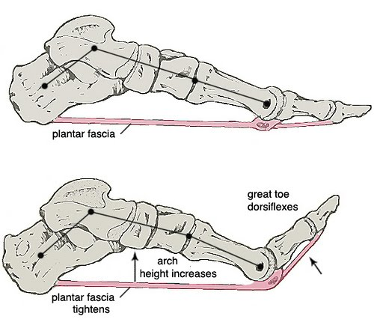
During running, the fascia functions as a critical load distributor and shock absorber, transferring ground reaction forces through the arch. The architecture of the fascia, with its longitudinal organisation and attachment pattern, creates a mechanical system designed to resist tensile and compressive forces during the impact and propulsion phases of running. At foot strike, the fascia becomes progressively taut as the arch loads with energy. At push-off, the fascia and intrinsic foot muscles work synergistically to release this energy, and power forward propulsion.4
This demand increases depending on the task performed. For reference, the plantar fascia deals with approximately 0.9x body weight force during slow walking. This demand increases exponentially during running, with some studies suggesting forces up to 3.7 - 4.8x body weight.5
MECHANICAL LOAD AND STRUCTURAL CHANGE
Plantar fasciopathy develops through accumulation of mechanical loading stress at the fascia-calcaneal insertion and mid-substance. Repetitive microtrauma from excessive tensile loading, combined with inadequate load tolerance, gradually leads to changes: collagen fibre disorganisation, mucoid degeneration, and neovascularisation.¹ These degenerative changes are not typically inflammatory; rather, the condition reflects failed tissue adaptation to cumulative loading. The factors leading to the tissue's inability to deal with and adapt to loads is multifactorial, with considerations that are both internal and external to the individual. It is important to note that the evidence supporting these factors as causative is limited, and careful consideration must be given to their roles in each individual case.6 Running training errors, that is, sudden increase in running volume (>10% per week), intensity progression, surface changes (transition from track to road, treadmill to trail), or sudden footwear changes (particularly transition to minimalist shoes) can overwhelm load tolerance.
A list of internal and external factors can be seen below:
Internal factors
- Higher BMI
- Limited first-toe extension range of motion
- Decreased strength and endurance, both locally at the foot and higher up the kinetic chain
- Metabolic factors (diabetes, menopause)*
External factors
- Training errors (volume, intensity, frequency)
- Footwear (carbon-plated, neutral, supportive)
- Running surface and elevation
- Occupation — particularly roles requiring long periods of standing
*Metabolic factors are associated rather than causative, likely reflecting tissue biology and adaptability.
REHABILITATION PRINCIPLES AND PROGRESSIONS
Plantar fasciopathy rehabilitation progresses through three phases: load modification, rebuilding, and return to full activities. Early return to running or increasing loads (too soon, too fast) is the primary cause of relapse; runners must understand that symptom absence does not equate to tissue readiness. Equally, it is also important to remember that one can still train with discomfort, so long as that discomfort does not worsen with each bout of activity over a 24 hr window. An acceptable amount is generally considered pain <3/10 during and after activity that settles back to baseline within 24 hrs.
EARLY PHASE: LOAD REDUCTION
Reduce running volume to a tolerable amount, limit high-intensity efforts (tempo runs, speed work, hills), and transition to run-walk intervals (1:1 run:walk). If pain is severe, consideration may be given to cease running for a short period of time to allow symptoms to settle. In these severe instances, consideration is also given to total daily, as well as weekly walking volume. Substituting with pain-free cross-training: cycling, pool running, swimming is a great option during this phase. Foot intrinsic exercises may serve a purpose here to strengthen the tissues locally. Bouts of plyometric exercises may also be a nice substitute for running, should symptoms be too severe.
INTERMEDIATE PHASE: REBUILDING
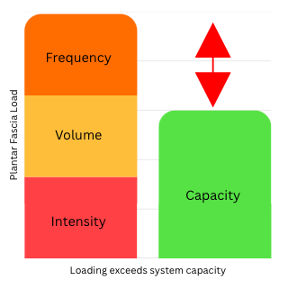
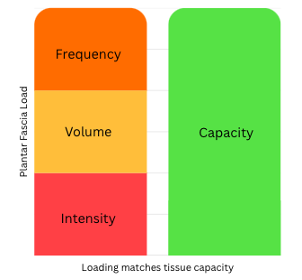
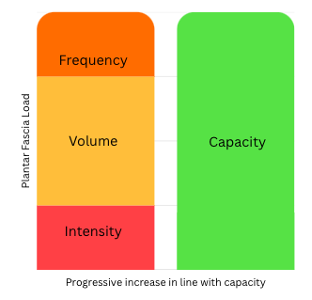
Once a sustainable volume and intensity of running has been identified, and symptoms remain steady, then you can begin to gradually increase running parameters. There are 3 elements of running that can be modified: intensity (how hard), volume (how much), frequency (how often). We encourage you to only modify one element at a time to avoid a load spike. This also allows you to identify what may lead to an increase in symptoms, should a flare up occur. Continuing to build intrinsic foot strength as well as strength globally is still relevant in this phase.
RETURN TO FULL ACTIVITIES
A return to normal activities generally occurs when load has been gradually increased, with symptoms remaining stable. Remember, you can still return to full activities with some discomfort, so long as that discomfort remains manageable and does not worsen. It is important at this stage to also consider global tissue resilience, particularly strength and endurance of key muscle groups including the calves, hips and foot intrinsics.
ADDITIONAL MODALITIES
FOOTWEAR
This is an area where there are strong clinical recommendations but relatively little high-quality direct evidence. Most guidelines recommend footwear optimisation as an adjunct to exercise rather than a stand-alone treatment.7 Considerations could be given for using stiffer shoes, or, shoes with a rocker shape, which can theoretically reduce the amount of mid to forefoot range of motion, and therefore the amount of load through the fascia.
TAPING & ORTHOTIC SUPPORT
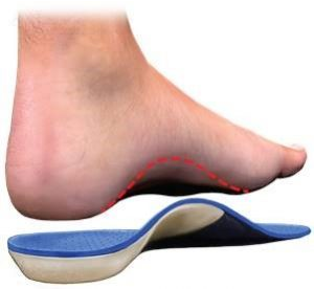
Similarly to shoe type, custom or semi-custom foot orthoses may help to reduce fascia load, and therefore help to reduce symptoms in the short term. Orthoses providing arch support and controlling medial arch collapse reduce load on irritable tissues. Again, it is important to highlight that the effects of orthotic support do not outperform other interventions, and generally derive small improvements over 6-12 weeks. A prefabricated, off the shelf supportive orthoses performs similarly to custom orthoses in many cases.7
Your physiotherapist may utilise some taping early on, mimicking the effects of an orthosis to determine suitability.
CONCLUSION
Plantar fasciopathy, while common in runners, demands accurate diagnosis and systematic rehabilitation targeting the mechanical sensitivity and underlying changes. For runners, the distinction between fasciopathy and other heel pain generators is critical; misidentification leads to ineffective training modifications and prolonged time off running.
Rehabilitation success in runners depends on early training modification and load reduction, progressive strengthening, and criterion-based, gradual return to running. The majority of presentations improve within 8–12 weeks with evidence-based conservative management and disciplined adherence to return-to-running progression. However, some cases may become persistent. The most common cause of relapse is premature return to running or too-rapid load progression; runners must resist the temptation to "push through" and persevere through early symptoms.
If you’re dealing with heel pain or suspect plantar fasciitis, consider a running injury assessment for an individualised, load-based rehabilitation plan.