Heart rate zones divide exercise effort into bands. In this guide, zone 2 means easy, steady aerobic exercise below or around your first lactate or ventilatory threshold. Formulas offer a starting estimate; a well-conducted test can identify more individual training boundaries.1,2
If your watch keeps telling you to slow down, it is worth understanding where its numbers came from. A coloured zone looks precise, but it may be based on little more than your age. Here is how to read those numbers, check them against your effort and find a range you can use.
Key Takeaways
- Zone 2 is an individual range, not a number you can get from your age alone.
- Age formulas can be well off: in one large study, 220 − age had a standard error of about 12 bpm.
- Check your app's method first: percentage of maximum, heart-rate reserve and threshold-based zones all give different numbers.
- Comfortable conversation is a practical field check, but it cannot give you an exact heart-rate boundary.
- Blood lactate threshold testing links your own LT1 and LT2 to heart rate and pace, so your zones are based on your physiology.
What are heart rate zones?
Heart rate zones are ranges of beats per minute used to organise training intensity. They help you distinguish an easy session from a harder workout. Five-zone systems are common, but their boundaries depend on the method used, so the same heart rate can receive different labels.3,4
Heart rate zones: a general guide
- Zone 1 – very easy: gentle effort, relaxed breathing. Used for warm-ups, cool-downs and very easy movement.
- Zone 2 – easy: steady effort, comfortable conversation. Used for easy endurance sessions.
- Zone 3 – moderate: more purposeful effort; talking takes more work. Used for planned steady or tempo work.
- Zone 4 – hard: demanding effort; conversation is difficult. Used for threshold-focused workouts.
- Zone 5 – very hard: very demanding breathing, little conversation. Used for short, high-intensity intervals.
This is a general coaching guide, not a measured prescription. It combines common five-zone descriptions with the easy-zone convention used here; exact boundaries vary.3,4
There is an especially confusing difference in research: a three-zone model calls exercise below the first threshold "zone 1", with "zone 2" between the first and second thresholds. That middle zone is harder than the easy zone 2 discussed in this article. Check the model before comparing training advice.4
What is zone 2 cardio?
Zone 2 cardio, as used here, is continuous aerobic activity kept below or near your first physiological threshold. You are working, but conversation remains comfortable. Walking, running or cycling can provide that effort; the activity name does not determine the zone. Your response to the workload matters.1,24
The first lactate threshold, or LT1, describes the initial sustained rise in blood lactate above its baseline during an incremental test. The first ventilatory threshold, VT1, is identified from changes in breathing and gas-exchange measurements. They are related markers, measured differently, and need not coincide exactly.1,2
For an everyday check, try saying a few complete sentences aloud. If speaking feels strained, ease off. Research supports comfortable speech as a practical guide to exercising below the ventilatory threshold, although it cannot give you an exact heart-rate boundary.5
For zone 2 training, think in terms of a range. You do not need to spend every minute pressed against its upper limit.
How to calculate zone 2 heart rate
If you are wondering how to calculate heart rate zones, first check your app's method. Many use a percentage of maximum heart rate; others use heart-rate reserve or a threshold estimate. These calculations produce different numbers, and none measures your first threshold simply by doing the arithmetic.1,6
The familiar estimate is maximum heart rate = 220 − age. Tanaka and colleagues proposed 208 − (0.7 × age) after analysing published research and testing a separate group of healthy adults. Both predict a population average rather than your personal maximum.7
Take a hypothetical 40-year-old:
- 220 − 40 predicts a maximum of 180 bpm.
- 208 − (0.7 × 40) also predicts 180 bpm.
- An app using 60–70% of maximum labels 108–126 bpm as zone 2. That percentage band appears in Garmin's published five-zone guide.3
Heart-rate reserve, used in the Karvonen method, includes resting heart rate. First subtract resting heart rate from maximum heart rate. Multiply that reserve by the chosen fraction, then add resting heart rate back.6
With an estimated maximum of 180 and resting heart rate of 60, the reserve is 120. For illustration, 60–70% of reserve gives 132–144 bpm: 60 + (0.60 × 120) through to 60 + (0.70 × 120).
Those percentages are used here to show the arithmetic, not to prescribe a heart-rate-reserve zone 2 band. A percentage of maximum and the same percentage of reserve are different calculations. Record the method beside the number before using either.
Why formula zones can be wrong for you
Formula zones can miss because people of the same age have different maximum heart rates, and thresholds do not occur at one universal percentage of maximum. Separately, your heart-rate response changes with exercise conditions. A number that suits a cool morning may need different interpretation during a hot run.1,8,9
In the HERITAGE study, involving 762 sedentary adults, the standard errors of estimate were 12.4 bpm for 220 − age and 11.4 bpm for Tanaka's equation. These describe prediction error in that sample, not a personalised allowance to add or subtract. Some individual errors were larger.8
The arithmetic can magnify the practical confusion. If your true maximum were 195 rather than a predicted 180, 70% would be about 137 instead of 126 bpm. This hypothetical example shows an 11 bpm difference before considering where your threshold actually falls.
Your training log also needs context:
- Heat and duration: heart rate can drift upwards during prolonged steady exercise. Heat strain and dehydration can further change the cardiovascular response. On a humid Brisbane summer day, record the conditions alongside pace and heart rate.9,10
- Caffeine: it can alter exercise heart rate, but "coffee always raises it" is too simple. Controlled research has also found lower heart rates during submaximal exercise after caffeine.11
- Sleep: sleep deprivation can make exercise feel harder even when heart rate changes little.12
- Illness: acute infection can be associated with an elevated resting heart rate; the number alone cannot diagnose what is happening.13
Avoid rewriting your zones after one unusual session. Look at the pattern, how you feel and what was different that day.
How to find your zone 2 heart rate accurately
A graded exercise test can estimate your threshold from your own responses, then connect it with heart rate and pace or cycling power. Blood lactate testing examines the lactate curve; appropriate gas analysis examines ventilatory responses. Both require a suitable protocol and interpretation, rather than a single universal cut-off.1,2
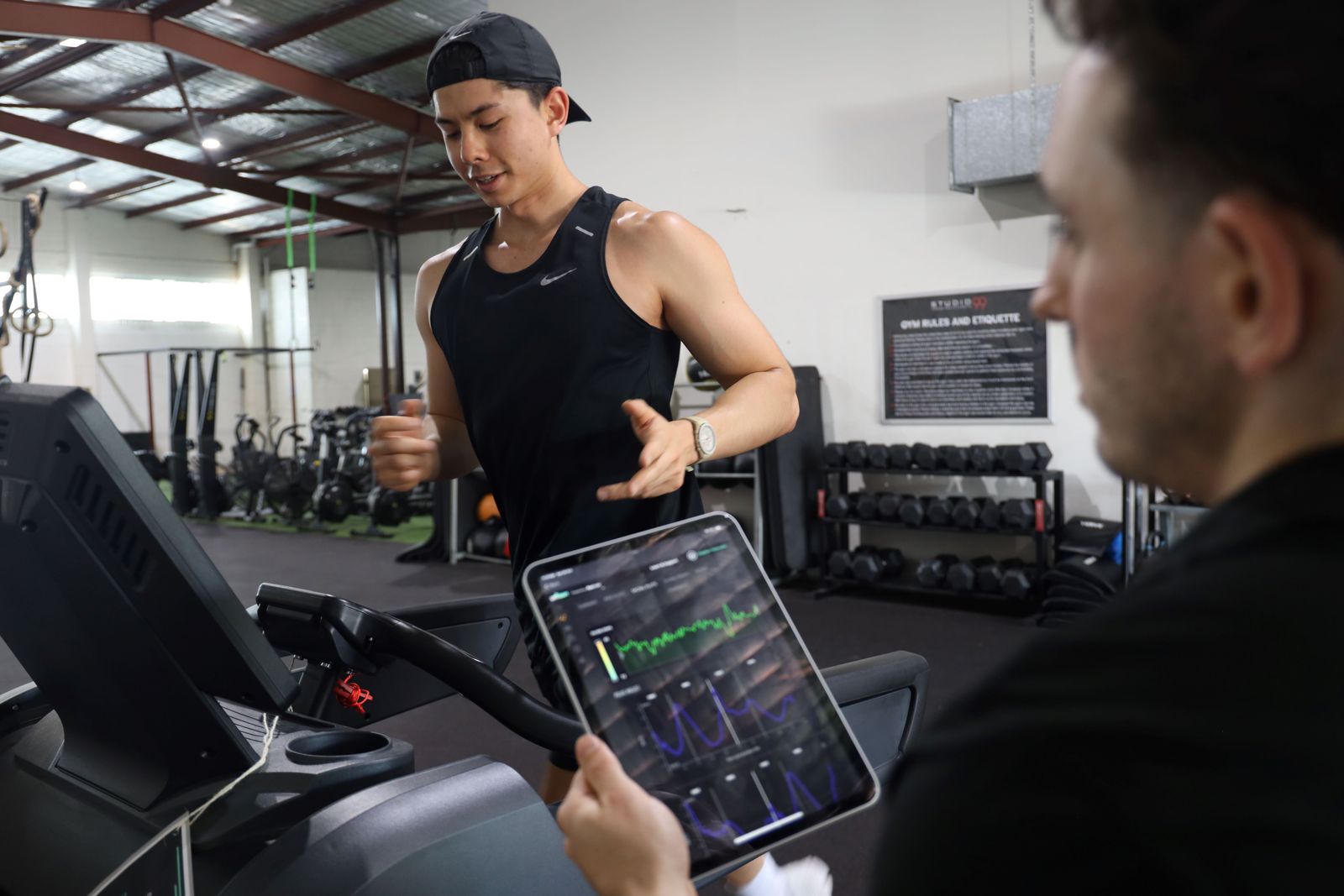
At GymTherapy, our blood lactate threshold testing uses a stepped treadmill or bike protocol. Small capillary blood samples are taken at the end of stages, and lactate values are considered alongside heart rate and workload. The results are used to identify LT1 and LT2 and discuss individual training zones.14
Our combined threshold and VO₂ max test adds a gas-analysis ramp test after a recovery interval. It brings threshold information and aerobic-capacity measurement into the same assessment. Ask your clinician which thresholds were identified and how they map onto the zones in your training app.15
LT2 refers to a higher-intensity lactate threshold concept. It should not automatically be treated as identical to maximal lactate steady state, which requires a different assessment approach. Nor does crossing a threshold mean your aerobic energy supply suddenly switches off.1,2
A useful report should explain the method, exercise mode and working ranges. Ask: "Which heart rate should guide my easy sessions, and how should I adjust for conditions?" Keep the report so later comparisons use the same terminology.
For the wider reasons to test, see the benefits of lactate threshold testing.
Field checks and their limits
Without a test, comfortable conversation is a reasonable starting check. Choose a familiar route, begin gently and notice when speech becomes less comfortable. Use that information to keep easy sessions conservative, rather than announcing that you have measured LT1.24
Nose breathing can be a personal cue, but it is not a reliable sign that you are below threshold. A study of restricted nasal breathing during self-selected easy cycling found no significant change in time spent in training zones. Do not force a breathing pattern to satisfy a zone rule.16
What is zone 2 running, and why does it feel so slow?
Zone 2 running means choosing a running effort that stays easy for you, rather than chasing a set pace. It can feel surprisingly slow when your usual run is harder than that. Hills and hot conditions can also make an easy-effort session require a slower pace or walking breaks.9,24
Think about the session's purpose: an easy outing you can keep conversational. Start with a route where you can adjust freely. A steep hill is a sensible place to walk if jogging makes that conversation difficult.
For example, imagine your planned easy run includes a climb halfway through. Shorten your stride or walk, then resume jogging when the effort settles. You are still following the session's purpose. There is no requirement to maintain an uninterrupted running pace.
If even a gentle jog feels too hard, use walk–run intervals while you check whether the watch settings are appropriate. Do not turn every outing into a battle to satisfy an unverified limit.
Compare similar routes and conditions over time. A humid afternoon and a cool morning are poor settings for judging yourself against one pace target.9
How much easy training do runners do?
Endurance athletes commonly complete most training at low intensity, with a smaller amount of harder work. That supports giving easy sessions a clear place in your week, but it does not establish one compulsory split for everyone. Training history, total volume and how intensity is counted all matter.17,18
Seiler's 2010 review described a common pattern among successful endurance athletes: about 80% of sessions at low intensity and about 20% dominated by harder work. These were often athletes training 10–13 times per week. That context matters if you run three times a week.17
Stöggl and Sperlich's 2014 study compared four approaches over nine weeks in 48 well-trained endurance athletes. Polarised training produced the largest improvements in several measured performance variables. It was a specific intervention in trained people, not proof that every recreational runner should copy the program.18
Counting sessions also differs from counting every minute: a harder session can include an easy warm-up and recoveries. "80/20" needs a definition before it becomes useful.4
The practical question is whether each session has a purpose you understand. Discuss the balance with your coach or clinician rather than adding hard sessions solely to complete a ratio.
Zone 2 and long-term health
Higher cardiorespiratory fitness is associated with lower mortality in large observational studies. Easy aerobic activity can form part of an active routine, but this evidence does not show that one particular zone label delivers longer life. Your overall activity and health context matter more than achieving a perfect watch chart.19,20
Mandsager and colleagues followed 122,007 adults referred for treadmill testing. Higher estimated fitness was associated with lower all-cause mortality. The study did not test a zone 2 program or establish that raising an individual score causes a particular lifespan change.19
For broader context, the World Health Organization's 2020 guidelines recommend 150–300 minutes of moderate-intensity aerobic activity, or 75–150 minutes of vigorous activity, or an equivalent combination each week. These public-health categories do not translate directly into one watch manufacturer's zones. The guidelines also include muscle-strengthening activity.20
Explore VO₂ max testing to understand fitness assessment alongside your training zones.
Frequently Asked Questions
What is my zone 2 heart rate?
It is the heart-rate range associated with easy effort in the model used here, with its upper boundary near your first threshold. To find your own, use a threshold assessment or a cautious conversational estimate; age alone cannot identify it.2,5,8
How do I calculate zone 2?
Check whether your app uses maximum heart rate, heart-rate reserve or threshold-based zones. Apply that method's percentages to the correct input. The worked example above shows the calculation, but the output remains an estimate unless linked to your measured responses.6,8
What is zone 2 cardio?
It is easy, steady aerobic activity, defined here as below or around your first threshold. Running, cycling and walking can all qualify when their effort suits you. Comfortable conversation is a useful field check, rather than a measurement of the threshold itself.1,24
Is zone 2 the same as the "fat-burning zone"?
Not exactly. Fat and carbohydrate both contribute to exercise energy, and their contributions change with intensity and duration. The intensity of maximal fat oxidation also varies between people. These observations do not establish a universal watch zone or promise body-fat loss from training within it.21,22
Why does zone 2 running feel so slow?
You may be comparing an easy-effort target with a faster habitual pace, or using unsuitable watch settings. Heat can also change the heart-rate response. Check the method and conditions, and allow walking when needed to keep conversation comfortable.5,6,9
How long should a zone 2 session be?
There is no universal minimum session length that makes exercise "count". WHO guidance recognises activity accumulated in bouts of any duration. Choose a duration that fits your current capacity and weekly plan; longer is not automatically the right next step.20
Are my watch's heart-rate zones accurate?
There are two questions: whether the sensor reads heart rate accurately, and whether its zone boundaries suit you. Research has found accuracy varies between devices and activities. A more reliable reading cannot correct an unsuitable zone calculation.23
Find your real zones
Book blood lactate threshold testing, or speak with RunLab about the assessment that fits your running. Bring your watch settings and recent training so you can leave with ranges you understand.
Written by James McMulkin, physiotherapist at GymTherapy. This article is general information and is not a substitute for an individual assessment or personalised medical advice.
Book Now
References
- Jamnick NA, Pettitt RW, Granata C, Pyne DB, Bishop DJ. An examination and critique of current methods to determine exercise intensity. Sports Medicine. 2020;50:1729–1756. DOI: 10.1007/s40279-020-01322-8.
- Faude O, Kindermann W, Meyer T. Lactate threshold concepts: how valid are they? Sports Medicine. 2009;39(6):469–490. DOI: 10.2165/00007256-200939060-00003.
- Garmin. Heart rate zone calculations (owner's manual). Manufacturer's example of a five-zone percentage-of-maximum model. Accessed 5 November 2026.
- Stöggl TL, Sperlich B. The training intensity distribution among well-trained and elite endurance athletes. Frontiers in Physiology. 2015;6:295. DOI: 10.3389/fphys.2015.00295.
- Reed JL, Pipe AL. The talk test: a useful tool for prescribing and monitoring exercise intensity. Current Opinion in Cardiology. 2014;29(5):475–480. DOI: 10.1097/HCO.0000000000000097.
- Garmin. Forerunner 245 owner's manual: Setting your heart rate zones. Documents maximum-heart-rate, reserve and manual settings. Accessed 5 November 2026.
- Tanaka H, Monahan KD, Seals DR. Age-predicted maximal heart rate revisited. Journal of the American College of Cardiology. 2001;37(1):153–156. DOI: 10.1016/S0735-1097(00)01054-8.
- Sarzynski MA, et al. Measured maximal heart rates compared to commonly used age-based prediction equations in the HERITAGE Family Study. American Journal of Human Biology. 2013;25:695–701. DOI: 10.1002/ajhb.22431.
- González-Alonso J, Mora-Rodríguez R, Below PR, Coyle EF. Dehydration markedly impairs cardiovascular function in hyperthermic endurance athletes during exercise. Journal of Applied Physiology. 1997;82(4):1229–1236. DOI: 10.1152/jappl.1997.82.4.1229.
- Coyle EF, González-Alonso J. Cardiovascular drift during prolonged exercise: new perspectives. Exercise and Sport Sciences Reviews. 2001;29(2):88–92. PMID: 11337829.
- Glaister M, Williams BH, Muniz-Pumares D, Balsalobre-Fernández C, Foley P. The effects of caffeine supplementation on physiological responses to submaximal exercise in endurance-trained men. PLOS ONE. 2016. DOI: 10.1371/journal.pone.0161375.
- Martin BJ. Effect of sleep deprivation on tolerance of prolonged exercise. European Journal of Applied Physiology and Occupational Physiology. 1981. DOI: 10.1007/BF02332962.
- Radin JM, Wineinger NE, Topol EJ, Steinhubl SR. Harnessing wearable device data to improve state-level real-time surveillance of influenza-like illness in the USA: a population-based study. The Lancet Digital Health. 2020. DOI: 10.1016/S2589-7500(19)30222-5.
- GymTherapy. Blood lactate threshold testing in Brisbane. Service and protocol description. Accessed 5 November 2026.
- GymTherapy. Combined threshold + VO₂ max testing in Brisbane. Service and protocol description. Accessed 5 November 2026.
- Rappelt L, et al. Restricted nasal-only breathing during self-selected low intensity training does not affect training intensity distribution. Frontiers in Physiology. 2023;14:1134778. DOI: 10.3389/fphys.2023.1134778.
- Seiler S. What is best practice for training intensity and duration distribution in endurance athletes? International Journal of Sports Physiology and Performance. 2010;5(3):276–291. DOI: 10.1123/ijspp.5.3.276.
- Stöggl T, Sperlich B. Polarized training has greater impact on key endurance variables than threshold, high intensity, or high volume training. Frontiers in Physiology. 2014;5:33. DOI: 10.3389/fphys.2014.00033.
- Mandsager K, et al. Association of cardiorespiratory fitness with long-term mortality among adults undergoing exercise treadmill testing. JAMA Network Open. 2018;1(6):e183605. DOI: 10.1001/jamanetworkopen.2018.3605.
- Bull FC, et al. World Health Organization 2020 guidelines on physical activity and sedentary behaviour. British Journal of Sports Medicine. 2020. DOI: 10.1136/bjsports-2020-102955.
- Romijn JA, et al. Regulation of endogenous fat and carbohydrate metabolism in relation to exercise intensity and duration. American Journal of Physiology. 1993;265:E380–E391. DOI: 10.1152/ajpendo.1993.265.3.E380.
- Achten J, Jeukendrup AE. Maximal fat oxidation during exercise in trained men. International Journal of Sports Medicine. 2003;24:603–608. DOI: 10.1055/s-2003-43265.
- Gillinov S, et al. Variable accuracy of wearable heart rate monitors during aerobic exercise. Medicine & Science in Sports & Exercise. 2017;49:1697–1703. DOI: 10.1249/MSS.0000000000001284.
- Persinger R, Foster C, Gibson M, Fater DCW, Porcari JP. Consistency of the talk test for exercise prescription. Medicine & Science in Sports & Exercise. 2004;36(9):1632–1636. PMID: 15354048.