What is a good VO₂ max? A useful starting point is a result at or above the median (50th percentile) for your age and sex. In this guide, we describe results at or above the 80th percentile, the top fifth of your age group, as excellent. These are plain-language descriptions, not diagnostic categories.
The VO₂ max charts below use directly measured treadmill results from the 2022 update of the FRIEND registry (the Fitness Registry and the Importance of Exercise National Database). The original FRIEND treadmill standards appeared in 2015, and the update expanded the reference sample. [1], [2]
These are US reference data, not an Australian population survey or a league table of runners. Start with your age group, then consider how your result was measured and what you want to do with it.
What is VO₂ max?
VO₂ max is the highest rate at which your body can take in and use oxygen during hard exercise. It is a measure of cardiorespiratory fitness, usually written in millilitres of oxygen per kilogram of body weight per minute (mL/kg/min). A result of 40 mL/kg/min means about 40 mL of oxygen per kilogram each minute at your measured maximum. [1], [3]
The "per kilogram" part matters. For example, 3,000 mL/min divided by 75 kg gives 40 mL/kg/min. At 70 kg, the same oxygen uptake gives about 42.9 mL/kg/min. That is why a change in the number doesn't always mean your aerobic capacity has changed.
For the broader picture, read how VO₂ max applies to sport and longevity.
VO₂ max chart for men by age
For men, start with the 50th percentile (median) column in your age row, then read across to see how your result compares with other men in that decade. The table describes a reference group. Deciding whether your number suits your goals takes a more individual conversation. [2]
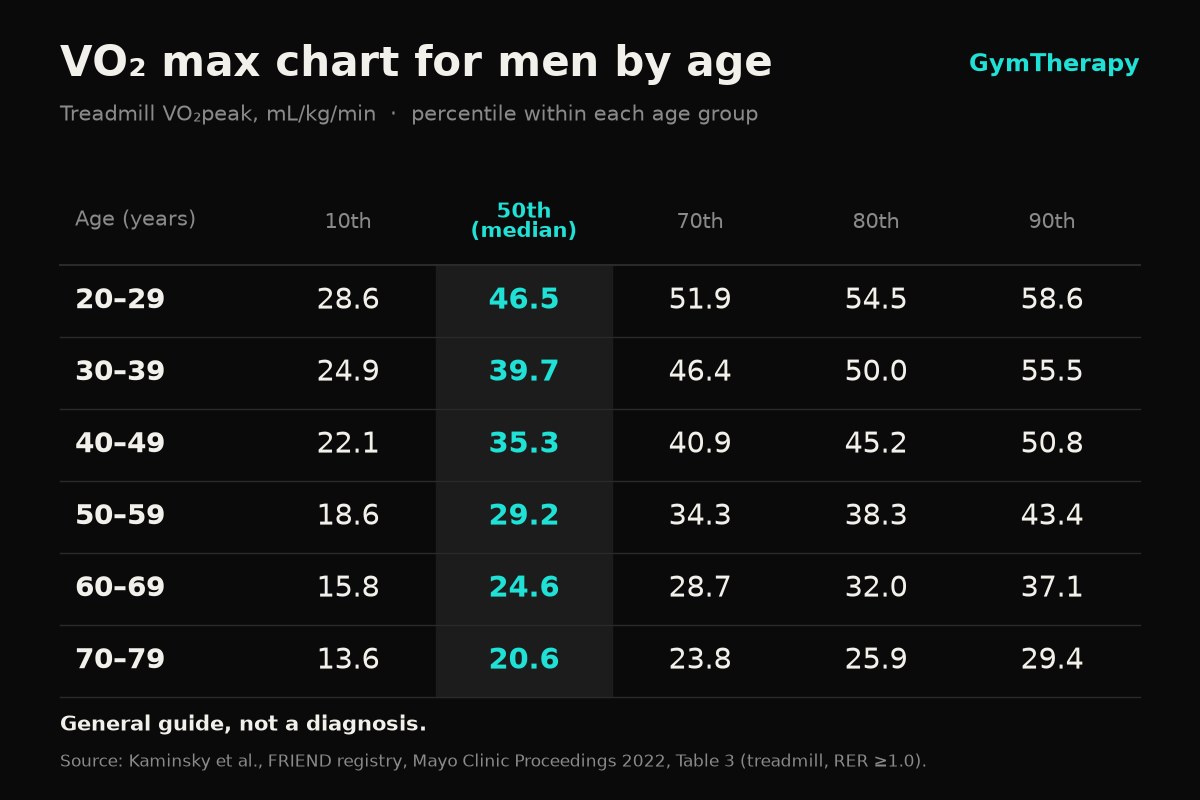
Median VO₂ max for men falls from 46.5 mL/kg/min at 20–29 to 39.7 at 30–39, 35.3 at 40–49, 29.2 at 50–59, 24.6 at 60–69 and 20.6 at 70–79. [2]
VO₂ max chart for women by age
For women, use the women's reference table and your current age group. Start at the median, then check the higher percentile columns. Keep the testing method alongside the number, particularly if you are comparing a watch estimate with a result measured during exercise. [2], [3]
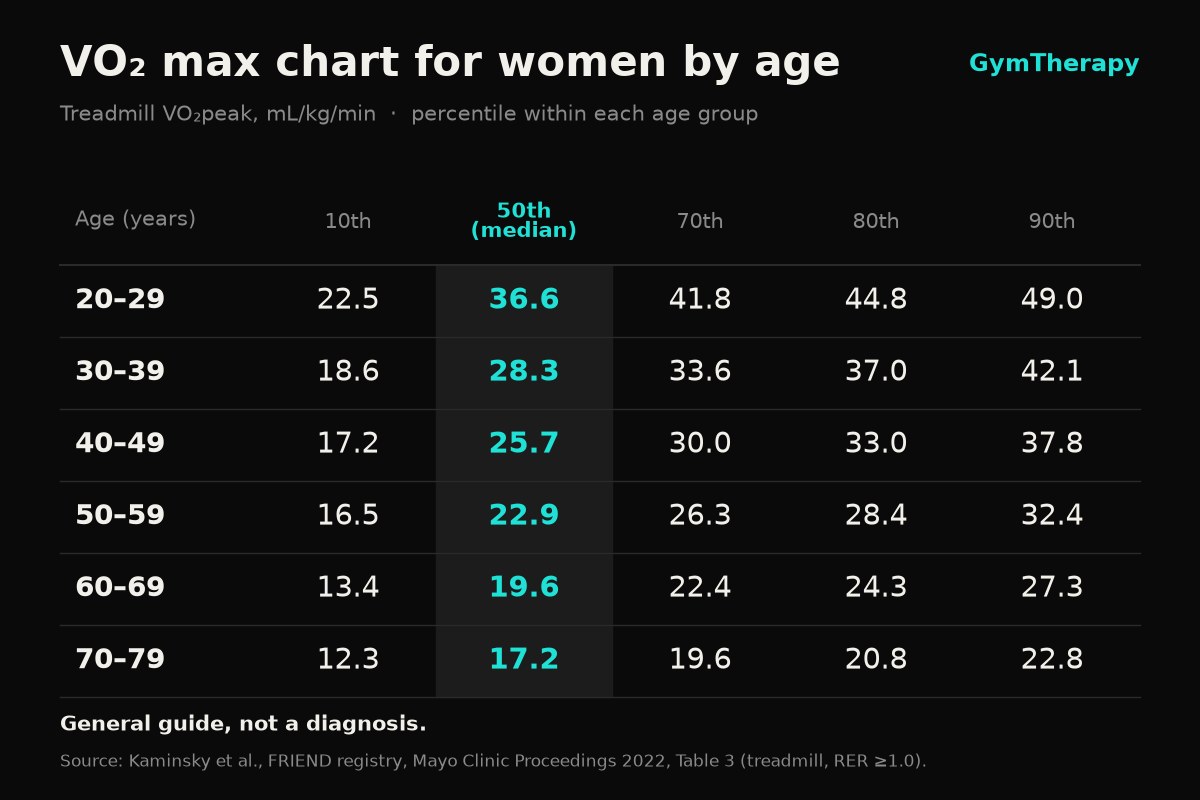
Median VO₂ max for women falls from 36.6 mL/kg/min at 20–29 to 28.3 at 30–39, 25.7 at 40–49, 22.9 at 50–59, 19.6 at 60–69 and 17.2 at 70–79. [2]
How to read your number
A percentile tells you where your result sits within a reference group. At the 50th percentile, around half the group scored lower and half higher. At the 80th, around 80% scored lower. It does not mean you have 80% of your possible fitness, and it doesn't predict your race placing.
Imagine you are a 45-year-old woman with a treadmill result of 33 mL/kg/min. In the women's 40–49 row, 33.0 is the 80th percentile, so your result is in the top fifth of that reference group. That counts as excellent under this article's description, but it doesn't tell you whether you are ready for a particular running event. [2]
- Between two columns? Describe it as a range, e.g. "between the 70th and 80th percentiles".
- Above the last column? That means above the 90th percentile. It doesn't show how far above.
- Two charts disagree? Check the year, population and exercise method each uses. Comparing a treadmill result with cycling norms, or switching datasets, can change the comparison even when your measured value stays the same.
The charts report VO₂peak, the highest oxygen uptake reached during testing, from treadmill tests that met an effort criterion (respiratory exchange ratio ≥1.0). They are not cycling or rowing norms. The FRIEND update also excluded people with known cardiovascular disease or chronic obstructive pulmonary disease. If either applies to you, ask your treating clinician to choose appropriate reference values. [2]
Keep a copy of your report with its units, date, protocol and reference source. That gives you something concrete to compare against at a later review.
What's a good VO₂ max for runners?
A good VO₂ max for a runner depends on your event, training background and the level you want to compete at. Your age percentile gives general context, but race performance also depends on running economy and how much of your aerobic capacity you can sustain. [4]
For recreational running, start with the question you want answered: are you trying to understand your starting fitness, prepare for a distance or improve a race time? You don't need an elite athlete's number as your personal target.
For context at the top end, a study of 16 world-class male distance runners in the Breaking2 project reported a mean laboratory VO₂peak of 71.0 ± 5.7 mL/kg/min. That is a small, highly selected male group, not a benchmark for every runner or for women. The same research looked at oxygen cost and lactate thresholds, which is why a VO₂ figure alone can't settle the performance question. [4]
If running is your focus, the GymTherapy RunLab is a place to discuss which assessments fit your event and current training.
Why VO₂ max matters for long-term health
In large observational studies, higher cardiorespiratory fitness is associated with lower long-term mortality. That makes fitness useful in a broader health discussion, but a VO₂ result can't tell you how long you will live, and an association doesn't prove that raising one test number causes a longer life. [5]
Mandsager and colleagues studied 122,007 adults referred for exercise treadmill testing, with a median follow-up of 8.4 years. Higher fitness was associated with lower all-cause mortality after adjusting for several measured risk factors. Exercise capacity in that study was estimated from treadmill workload (METs) rather than measured by gas analysis, and other differences between participants may have influenced the findings. [5]
Treat your result as one useful piece of information alongside your wider health assessment. If your interest goes beyond running, explore the longevity testing package.
Why your watch's number may differ from a lab test
Your watch estimates VO₂ max rather than measuring oxygen uptake through a mask. Apple's published method, for example, uses heart rate, motion and personal details to estimate fitness during outdoor activity. A lab test measures oxygen uptake during progressively harder exercise, so the two numbers can differ. [3]
How VO₂ max is measured properly
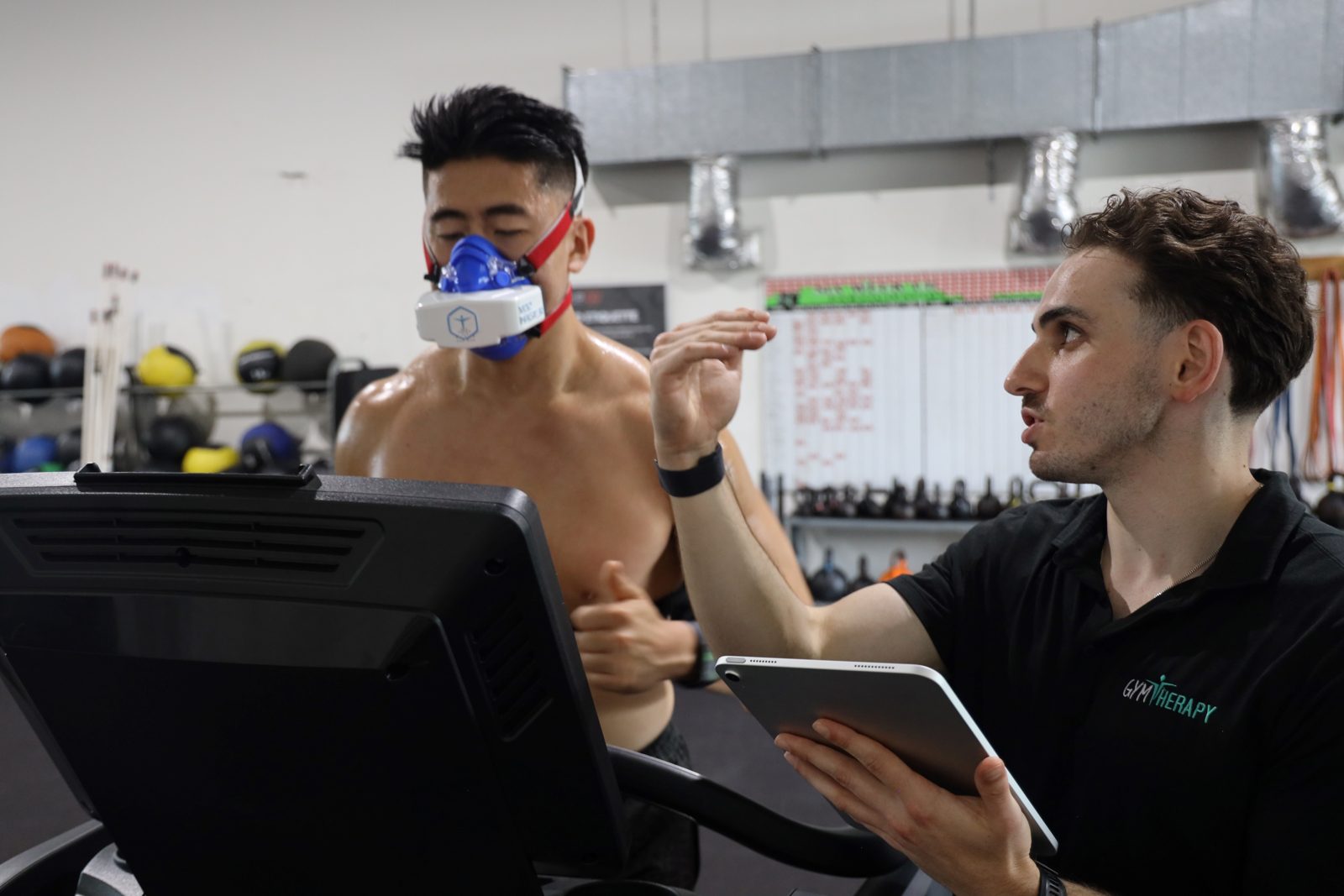
To measure VO₂ max directly, you exercise at increasing workloads while wearing a mask connected to a gas analyser. At GymTherapy, we use VO₂ Master Pro gas analysis with a graded treadmill protocol, or a bike or rower protocol chosen to suit your assessment and goals. [6]
- Health screen and chat about your training history and goals.
- Mask fitting and warm-up, including a check of the mask seal.
- Incremental test: speed or incline (treadmill) or resistance (bike) increases in stages while the clinician supervises, aiming for a valid peak effort.
- Cool-down and results review. Your report includes your measured value, an age-based comparison and training recommendations.
Ask which reference dataset was used and whether the report describes VO₂max or VO₂peak. "Peak" is the highest value recorded, because a test doesn't always show a clear physiological maximum. For follow-up tests, use the same exercise mode, equipment and preparation, because measurement systems and repeat testing introduce some variation. [2], [7]
Find out what is included in VO₂ max testing in Brisbane.
Can you improve your VO₂ max?
Yes. Aerobic training can improve VO₂ max, although individual responses vary. Build a consistent routine and progress the workload gradually. Higher-intensity intervals may be useful when they suit your health and training background, but a study's average improvement is not a promise about your own result. [8], [9]
ACSM guidance supports tailoring frequency, duration and intensity to your current activity, health, exercise response and goals, so discuss changes with your clinician or coach. There's no need to turn every session into a test. [9]
Frequently Asked Questions
What is a good VO₂ max for my age?
Use the row for your age and the chart for your sex. In this guide, at or above the 50th percentile (median) is a useful starting definition of good, and at or above the 80th percentile is described as excellent. These are descriptive labels, not medical thresholds. [2]
What is a good VO₂ max for a 40-year-old?
In the 2022 FRIEND treadmill data, the median for ages 40–49 is 35.3 mL/kg/min for men and 25.7 for women. The 80th percentiles are 45.2 and 33.0. Use the full decade's row rather than treating these as exact targets for a birthday. [2]
Is a VO₂ max of 45 good?
It depends on your age and sex. For a man aged 40–49, 45 sits just below the 80th percentile (45.2). For a woman aged 40–49, it is above the 90th percentile (37.8). For a man aged 20–29, it is below the median (46.5). [2]
Does VO₂ max decline with age?
On average, aerobic capacity declines with age, but no single fixed rate describes everyone. Longitudinal research shows the rate can change across adulthood. An age-group table compares different people, so it can't forecast your own result in ten years. [10]
How often should I retest my VO₂ max?
Base the timing on the decision the next test will inform, such as reviewing a completed training block. Keep testing conditions comparable and ask whether any change is bigger than expected measurement variation. The age charts themselves don't set a retesting schedule. [7]
Want to understand your own number? Book a VO₂ max test and bring your watch history, recent training and questions to the appointment.
Written by James McMulkin, physiotherapist at GymTherapy. Last reviewed November 2026. This article is general information only and is not a substitute for an individual assessment.
Book Now
References
- Kaminsky LA, Arena R, Myers J. Reference standards for cardiorespiratory fitness measured with cardiopulmonary exercise testing: data from the Fitness Registry and the Importance of Exercise National Database. Mayo Clinic Proceedings. 2015;90(11):1515–1523. DOI: 10.1016/j.mayocp.2015.07.026
- Kaminsky LA, Arena R, Myers J, et al. Updated reference standards for cardiorespiratory fitness measured with cardiopulmonary exercise testing: data from the Fitness Registry and the Importance of Exercise National Database (FRIEND). Mayo Clinic Proceedings. 2022;97(2):285–293. DOI: 10.1016/j.mayocp.2021.08.020
- Apple. Using Apple Watch to Estimate Cardio Fitness with VO₂ max. May 2021. Manufacturer technical paper
- Jones AM, Kirby BS, Clark IE, et al. Physiological demands of running at 2-hour marathon race pace. Journal of Applied Physiology. 2021;130(2):369–379. DOI: 10.1152/japplphysiol.00647.2020
- Mandsager K, Harb S, Cremer P, Phelan D, Nissen SE, Jaber W. Association of cardiorespiratory fitness with long-term mortality among adults undergoing exercise treadmill testing. JAMA Network Open. 2018;1(6):e183605. DOI: 10.1001/jamanetworkopen.2018.3605
- GymTherapy. VO₂ Max Testing in Brisbane. Service description and appointment process.
- Schoffelen PFM, den Hoed M, van Breda E, Plasqui G. Test-retest variability of VO₂max using total-capture indirect calorimetry reveals linear relationship of VO₂ and power. Scandinavian Journal of Medicine & Science in Sports. 2019;29(2):213–222. DOI: 10.1111/sms.13324
- Helgerud J, Høydal K, Wang E, et al. Aerobic high-intensity intervals improve VO₂max more than moderate training. Medicine & Science in Sports & Exercise. 2007;39(4):665–671. DOI: 10.1249/mss.0b013e3180304570
- Garber CE, Blissmer B, Deschenes MR, et al. Quantity and quality of exercise for developing and maintaining cardiorespiratory, musculoskeletal, and neuromotor fitness in apparently healthy adults: guidance for prescribing exercise. Medicine & Science in Sports & Exercise. 2011;43(7):1334–1359. DOI: 10.1249/MSS.0b013e318213fefb
- Fleg JL, Morrell CH, Bos AG, et al. Accelerated longitudinal decline of aerobic capacity in healthy older adults. Circulation. 2005;112(5):674–682. DOI: 10.1161/CIRCULATIONAHA.105.545459