Pain along the inside of the shin is one of the most common injuries affecting runners and field sport athletes. It is estimated to affect between 4% - 35% of runners.1 Often labelled as "shin splints," medial tibial stress syndrome (MTSS) is frequently misunderstood, leading many to simply rest until the pain settles before returning to training, or, push through the pain - only for symptoms to worsen. Current evidence suggests MTSS is not simply an inflammatory condition, but rather an early bone stress injury that develops when the tibia is exposed to more load than it can adapt to.2 If identified early and managed appropriately, most athletes make a full recovery. However, if ignored, MTSS can progress along the bone stress continuum towards a tibial stress fracture.
Understanding why MTSS develops, and addressing the contributing factors is essential for successful rehabilitation and reducing the risk of recurrence.
ANATOMY, PHYSIOLOGY AND THE BONE STRESS CONTINUUM
The tibia (shin bone) is one of the primary load bearing bones of the leg. Every stride, take-off and landing places considerable forces through the tibia. These forces are not inherently harmful. In fact, they help to make bones thicker, and therefore stronger. This occurs through a process of bone breakdown and then remodelling, an adaptation that makes bone more resilient. This is best described by Wolff’s Law - the principle that bone remodels according to the mechanical loads placed upon it. Appropriate loading strengthens bone; excessive loading without adequate recovery has the opposite effect. During running, the tibia experiences several times body weight with every step, resulting in thousands of loading cycles during a typical run. When these repetitive loads accumulate faster than the bone can remodel, symptoms develop. However, this occurs from a combination of multiple factors.3
Tipping into “overload” rarely occurs due to one single cause. Instead, it reflects the interaction between an athlete's intrinsic characteristics and the external loads placed upon the tibia. While some risk factors cannot be modified, many can be identified and addressed during rehabilitation.
Intrinsic factors include previous bone stress injuries, reduced calf or lower limb strength, altered running mechanics, limited ankle mobility, low energy availability, vitamin D deficiency and inadequate recovery. Collectively, these factors may reduce the bone's ability to tolerate repetitive loading.4
Extrinsic factors relate to the stresses applied to the body. Sudden increases in running volume or intensity, returning to sport after time away, changes in footwear, harder running surfaces and large volumes of sprinting or jumping all increase the mechanical demands placed on the tibia.
Ultimately, training load is the most modifiable risk factor. Successful rehabilitation focuses on identifying which factors are relevant to the individual, rather than assuming every case of MTSS develops for the same reason.
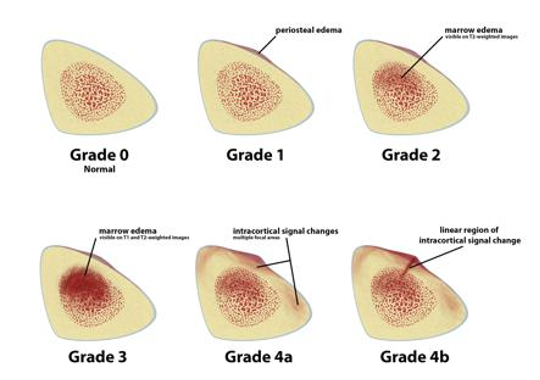
The Fredericson classification helps to conceptualise where one may sit on this continuum based on MRI.5 MTSS seems consistent with grades 1-2, where we see changes around the periosteum, the outermost layer of the tibia. It is around this point that people experience diffuse, aching pains along the tibia. Left unmanaged, this can then progress into grades 3-4, where bone breakdown becomes prominent in the deeper layer of bone. Once a breach is seen from superficial to deep, this becomes consistent with a stress fracture. It is important to note, however, that periosteal oedema does not diagnose MTSS - as there are people who have oedema on MRI, but have no pain.6 Clinical findings must align to determine the diagnosis.
CLINICAL ASSESSMENT & IMAGING
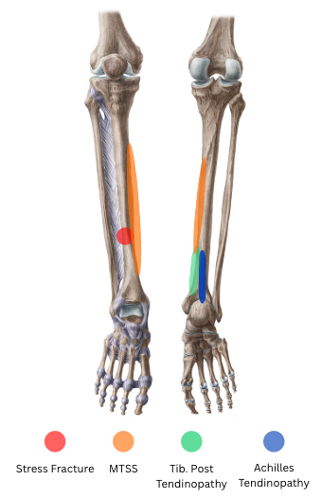
The diagnosis of MTSS is very much a clinical diagnosis, with an MRI best used to support and classify on the bone stress continuum. Clinical assessments generally include a combination of functional testing - that is, the ability to load through the calf, tolerance to jumping, hopping, as well as palpating the sensitive area. MTSS is generally felt on the posteromedial aspect of the tibia, and typically has a length >5 cm. If the sensitive area sits more anterior, and has a smaller radius <5 cm, then there may be suspicion of a tibial stress fracture.2 An MRI would be warranted in this case.
When looking through a broader lens, consideration is also given to running mechanics and local as well as proximal strength and endurance. Research suggests that an increase in duration in pronation during stance, as well as contralateral hip drop may predispose to its onset. A prospective study on cross country runners found that every 1% increase in pronation duration increased the odds of developing MTSS by 1.38x.7
THE OUTLOOK - NOT ALL DOOM AND GLOOM
The outlook of MTSS is excellent when identified early.
Athletes are generally able to continue running during this time with modifications to their running plan, so long as pain remains stable and does not worsen over 24 hrs. If worsening, then this would be a sign that you are pushing beyond what the bone can cope with. Continuing to train in this manner significantly increases the risk of progression to a stress fracture. For context, a tibial stress fracture, particularly the anterior aspect is considered a high risk fracture, as it does not have a great blood supply and therefore heals at a slow rate. These injuries would require several months away from running and sport.
Pain is rarely the problem itself. It is the body's signal that the current training load exceeds the bone's present capacity. Rehabilitation therefore focuses on increasing capacity rather than simply eliminating pain.
REHABILITATION
Rehabilitation for MTSS, put simply, is about preventing the bone from progressing through the bone stress continuum, and by providing enough of a stimulus to develop a stronger bone. Bone adapts positively to progressive mechanical stress, provided the loading is appropriate. Rehabilitation therefore aims to prevent progression along the bone stress continuum while gradually rebuilding capacity for running.
MANAGE TRAINING LOADS
The first step is reducing the amount of stress placed on the tibia to a level it can tolerate. Complete rest is rarely necessary. Instead, modifying running volume, frequency or intensity often allows symptoms to settle while maintaining enough stimulus for ongoing bone adaptation. Cross-training can also be used to preserve cardiovascular fitness while temporarily reducing repetitive tibial loading.
BUILD CAPACITY
As symptoms improve, attention shifts towards addressing the factors that contributed to the injury. Progressive strength training targeting the calf complex, lower limb and trunk improves the body's ability to absorb force, while gradually reintroducing impact through hopping, plyometrics and running helps stimulate bone remodelling.
PROGRESSIVE RETURN TO RUNNING
Running should be reintroduced gradually, beginning with walk-run intervals before progressing to continuous running, longer durations and eventually faster speeds or sport-specific training. Pain should remain mild (generally ≤3/10) and return to baseline within 24 hours. Rehabilitation should always be guided by symptoms and function rather than arbitrary timelines.
CONCLUSION
MTSS is far more than simply “shin splints”. It represents an early bone stress injury that develops when loading exceeds the bone’s ability to adapt. The goal of rehabilitation isn't to avoid loading the tibia, it is to restore its ability to tolerate it. When training load is progressed appropriately and the underlying contributing factors are addressed, bone adapts remarkably well, allowing most athletes to return to running stronger and more resilient than before.
If you’re dealing with shin pain or suspect MTSS, consider a running injury assessment for an individualised loading and rehabilitation plan.
Book Now
References
- Winters M. The diagnosis and management of medial tibial stress syndrome. Der Unfallchirurg. 2019;123:15-19. doi:10.1007/s00113-019-0667-z
- Moen M, Tol J, Weir A, Steunebrink M, Winter TC. Medial Tibial Stress Syndrome. Sports Medicine. 2009;39:523-546. doi:10.2165/00007256-200939070-00002
- Matijevich ES, Branscombe L, Scott LR, Zelik K. Ground reaction force metrics are not strongly correlated with tibial bone load when running across speeds and slopes: Implications for science, sport and wearable tech. PLoS ONE. 2019;14. doi:10.1371/journal.pone.0210000
- Becker J, Wu W. Factors Contributing to Medial Tibial Stress Syndrome in Runners: A Prospective Study. Medicine & Science in Sports & Exercise. 2018;50:2092–2100. doi:10.1249/mss.0000000000001674
- Franklyn M, Oakes B. Aetiology and mechanisms of injury in medial tibial stress syndrome: Current and future developments. World journal of orthopaedics. 2015;6 8: 577-89 . doi:10.5312/wjo.v6.i8.577
- Craig DI. Current Developments Concerning Medial Tibial Stress Syndrome. The Physician and Sportsmedicine. 2009;37:39 - 44. doi:10.3810/psm.2009.12.1740
- Becker J, James S, Wayner R, Osternig L, Chou L. Biomechanical Factors Associated With Achilles Tendinopathy and Medial Tibial Stress Syndrome in Runners. The American Journal of Sports Medicine. 2017;45:2614 - 2621. doi:10.1177/0363546517708193